Want to keep a record of a meeting, a tense phone call or a job interview, and wondering whether you’re allowed to hit record? The short answer: in the US, federal law and most states let you record a conversation you take part in without telling anyone, but around a dozen states require the consent of everyone involved. In the UK, recording your own conversation for personal use is generally legal; sharing it is another story.
In this guide (updated September 2026), I walk you through when it’s legal to record a conversation, the difference between one-party and all-party consent, which states are strict, how the UK handles it, and what happens when you want to use a recording as evidence. Then we get practical: meetings, calls, interviews and the workplace.
⚠️ This is not legal advice. I’m not a lawyer: this article summarizes published statutes and case law to help you see clearly. Recording laws change and depend on your exact situation, so talk to an attorney or solicitor for a real dispute.
Is it legal to record a conversation? The answer in 5 points ⚖️
- You take part in the conversation: under federal law and in most states, your own consent is enough (“one-party consent”). In the UK, recording a conversation you’re in is not a crime in itself.
- You’re a third party (a phone left recording in a room, listening in on a call between two other people): that’s eavesdropping or interception, illegal pretty much everywhere.
- Consent: in all-party consent states such as California, Florida or Pennsylvania, everyone must agree. A clear announcement at the start, followed by people carrying on, is the usual safe route.
- Evidence: a lawful recording can often be used in court. An unlawful one may be excluded and can expose you to criminal and civil liability.
- Sharing: publishing a recording raises separate issues (privacy, defamation, data protection in the UK). Recording is one question; posting it online is a much riskier one.
If you remember only one thing: when in doubt, announce the recording. It turns almost every gray area into a non-issue.
US law: one-party vs all-party consent 📜
The federal rule (18 U.S.C. § 2511)
The federal Wiretap Act is a one-party consent law: it’s lawful for a person to record a wire, oral or electronic communication when they are a party to it, or when one of the parties has given prior consent, unless the recording is made to commit a crime or a tort. That’s the floor. States can be stricter, and several are.
The all-party consent states
Based on 50-state surveys (Justia, the Reporters Committee for Freedom of the Press), these states generally require the consent of all parties to record a private conversation:
- California (Penal Code § 632, for confidential communications), Florida, Maryland, Massachusetts, Pennsylvania, Washington, Montana, New Hampshire and Illinois (private conversations).
- Nuanced cases: Nevada (all-party for phone calls, one-party in person), Oregon (all-party for in-person conversations, one-party for phone calls), Connecticut (one-party for criminal law, but written consent of all parties to avoid civil liability on calls) and Michigan (all-party on paper, but courts have let participants record their own conversations).
Everywhere else, one-party consent is the rule. But “confidential” or “private” matters: in several all-party states, the law only protects conversations where people reasonably expect privacy. A speech in a public square isn’t the same as a one-on-one call.
Calls across state lines
If you’re in Texas (one-party) and call someone in California (all-party), which law applies? Courts have gone both ways, but the California Supreme Court (Kearney v. Salomon Smith Barney, 2006) applied California law to calls recorded from out of state. The practical rule: when a call crosses state lines, follow the strictest law, which means getting everyone’s consent.
The penalties
They vary a lot. Federal interception can bring up to five years in prison. In California, an illegal recording can mean fines and jail time, plus a civil claim of up to $5,000 per violation. Florida treats unlawful interception as a felony. Not worth the risk for a meeting recap.
The UK: legal to record, careful with what you do next 🇬🇧
The UK has no general “all-party consent” rule for individuals. Recording a conversation you take part in, for your own use, is generally lawful. Intercepting a communication you’re not part of is a different matter and falls under the Investigatory Powers Act 2016.
Businesses are held to more: recording calls with customers or staff falls under the interception rules for businesses (the 2018 Monitoring and Record-keeping Regulations) and under UK GDPR. In practice, that means telling people calls are recorded, having a lawful basis and keeping recordings only as long as needed. For individuals, data protection mostly kicks in once you go beyond purely personal use, for example by sharing or publishing the recording.
Using a recording as evidence 🧑⚖️
In the US, a recording made lawfully (for example, by a participant in a one-party state) is often admissible, subject to the usual rules on authenticity and relevance. A recording made in breach of an all-party law can be excluded: California’s Penal Code, for instance, bars evidence obtained in violation of § 632 in most proceedings. You could also face a counterclaim.
In the UK, employment tribunals have admitted covert recordings. In Punjab National Bank v Gosain the Employment Appeal Tribunal allowed recordings of private discussions that were relevant to the claim, and in Phoenix House Ltd v Stockman the Employment Appeal Tribunal held that secretly recording a meeting doesn’t automatically destroy trust and confidence, while looking at purpose, culpability and subject matter. But a covert recording can still count as misconduct, so it’s a double-edged sword.
My take: a hidden recording isn’t a trump card. It helps most when it’s your only proof of something serious (harassment, pressure, a broken promise) and you only use the relevant part.
Practical cases: meetings, calls, interviews, work 🗂️
Recording a meeting
Team meetings, client meetings, board meetings: recording them for accurate notes is common. Because the recording will produce a shared document, treat it as professional use. Say it at the start, explain what it’s for, and send the transcript only to attendees. If someone objects, stop and take notes by hand. And if anyone joins from an all-party state, you need everyone’s agreement anyway.
Recording a phone call
Check where both of you are. One-party state to one-party state: your consent is enough. Any all-party state involved: ask. On iPhone, the built-in call recording feature automatically notifies everyone on the call, which I cover in my guide to recording calls on iPhone.
Recording a job interview or HR meeting
Secretly recording a recruiter rarely helps you and can backfire. For a disciplinary or HR meeting, ask upfront whether you can record, or ask for written minutes. In the UK, a covert recording might be admitted by a tribunal later, but your employer may also treat it as misconduct.
At work: colleagues, managers, employer
Leaving a recorder running in a room you’ve left is eavesdropping. Employers who record calls or meetings need clear policies and notice. If you’re dealing with harassment, start by documenting in writing and speak to a lawyer, a union or HR before reaching for a recorder.
My best practices to record a conversation safely ✅
- Announce it right away: “I’m going to record so I get an accurate transcript, is that OK?”
- Make it visible: a device on the table with a light beats a hidden mic. Continuing after a clear notice is widely treated as consent.
- Say what it’s for (notes, action items, personal memo) and who gets the transcript.
- Assume all-party rules whenever you’re not sure where the other person is.
- Don’t keep it forever: delete the audio when you no longer need it and keep the summary.
- Never post a recording without people’s clear agreement, and keep the original file untouched if a dispute is likely.
Pocket: the tool I use to record openly 🎙️
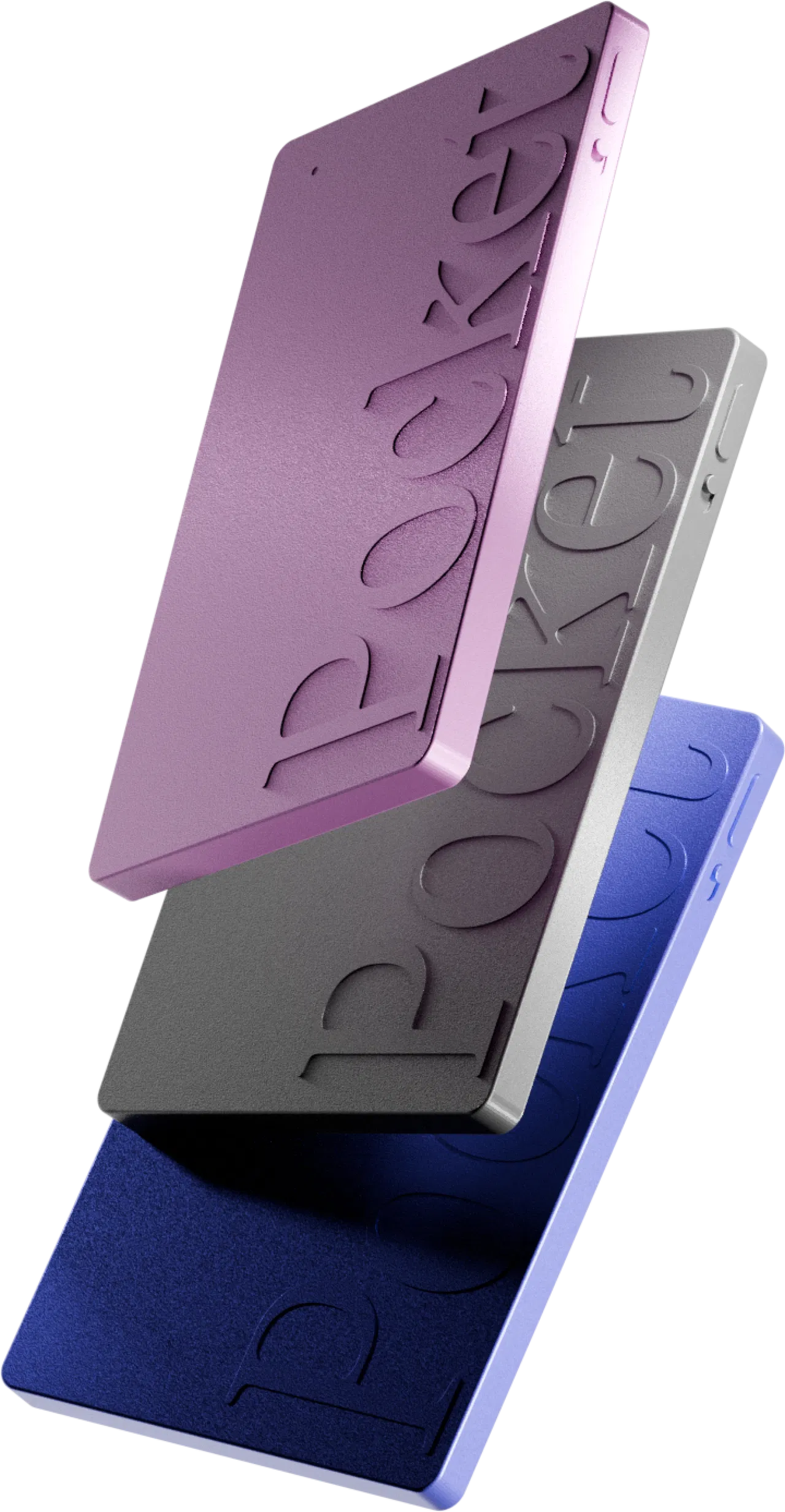
Once the legal side is sorted, the practical question remains: what do you record with? I’ve been using Pocket daily, and it’s a good example of a recorder that doesn’t pretend to be something else. One press on the side button and a light indicator turns on and the device vibrates: it’s not a spy gadget, people can see it, and that’s exactly how it should be.
What matters here: the call mode with a contact mic via MagSafe for phone calls, two studio mics for in-person conversations (15 m / 49 ft range), unlimited transcription with no subscription for a one-time price of around $129, then summaries, tasks and mind maps. On privacy, Pocket states end-to-end encryption, HIPAA compliance and a commitment never to sell or share your data. All the details are in my full Pocket review.
To be fair: Pocket isn’t designed for Zoom or Teams calls, and if you need a broad stack of certifications (ISO 27001, SOC 2, GDPR highlighted), Plaud keeps the edge there, as I explain in my Pocket vs Plaud comparison. And no device replaces announcing the recording: a tool doesn’t make an unlawful recording lawful.
Recap: recording a conversation in the US and UK 📋
Still comparing devices for meetings and calls? Check my guide to the best pocket voice recorder for the current options.
FAQ – Is it legal to record a conversation?
Can I record a phone call without telling the other person?
In a one-party consent state, if you’re on the call, yes. If either of you is in an all-party state such as California, Florida or Pennsylvania, you need everyone’s consent. In the UK, recording for personal use is generally lawful, but sharing it can create problems.
Which states are two-party (all-party) consent states?
Mainly California, Florida, Illinois, Maryland, Massachusetts, Montana, New Hampshire, Pennsylvania and Washington, with nuances in Nevada, Oregon, Connecticut and Michigan. Always check the current statute for your state.
Is a secret recording admissible in court?
Often, if it was made lawfully. A recording made in breach of an all-party law can be excluded in the US. UK employment tribunals have admitted covert recordings when relevant, but it’s decided case by case.
Can my employer record my calls?
Generally yes, with notice and a legitimate purpose, and in the UK with a lawful basis under UK GDPR. In all-party states, the people on the call must be told.
Can I post a recording on social media?
Avoid it without people’s agreement. Even a lawful recording can lead to privacy, defamation or data protection claims once it’s public.
My verdict 🏁
Is it legal to record a conversation? In most of the US and in the UK, yes, when you’re part of it. The real traps are the all-party consent states, calls across state lines, eavesdropping on others and posting recordings online. My rule fits in one line: announce it, keep it visible, keep it to yourself.
If you want a recorder that fits that rule, with a light when it starts, call mode and unlimited transcription with no subscription, Pocket is my pick for 2026.
Reminder: this is not legal advice. Laws and cases cited are current as of September 2026; for a specific situation, talk to an attorney or solicitor.