The short answer: in the Pocket vs Plaud match-up, Pocket AI wins for most people – the same AI power (transcription, summaries, action items, mind maps) but with no subscription, unlimited recording, more languages (120+), a longer 15 m mic range and a lower one-time price (~$129). Plaud still has the broader hardware range (Note, Note Pro, NotePin), a more mature app and stronger enterprise compliance. Here is the full pocket vs plaud comparison, model by model, updated July 2026.
Pocket vs Plaud: the verdict in 30 seconds
If you just want the bottom line of the pocket vs plaud debate: buy Pocket if you record often and hate subscriptions; consider Plaud if you need a specific form factor (a wearable pin, or the long-range Note Pro), a very mature app, or strict compliance certifications. Both capture in-person conversations and phone calls, both transcribe and summarise with AI, and both now have a desktop app and an MCP server. The real difference is the business model – Pocket includes its AI for life with unlimited recording, while Plaud meters your transcription in minutes once you pass the free tier. However you phrase it – pocket vs plaud ai, plaud vs pocket ai, or a full plaud vs pocket ai comparison, right down to the pocket ai vs plaud note comparison – the answer points the same way.
Pocket vs Plaud: the differences that actually decide it
Four things settle the pocket ai vs plaud comparison for most buyers. 1) Price over time: Pocket is a one-time ~$129 with an optional Pro plan (~$19.99/mo); Plaud is the device plus a subscription (Pro ~$8.33/mo billed annually, or Unlimited ~$19.99/mo) as soon as you record more than ~5 hours a month. 2) The AI experience: both give transcripts, summaries, tasks and mind maps, but Pocket adds “Ask Pocket” and lets you choose the AI model that writes your notes, while Plaud counters with polished speaker labels and reusable templates. 3) Hardware details that bite daily: Pocket reaches up to 15 m / 49 ft (vs ~3 m for a standard Plaud), starts on a single press, and charges over USB-C – no proprietary cable; Plaud is thinner and sits flat on a table. 4) Simplicity: Pocket handles 120+ languages and keeps it to pay once, record, done.
Pocket vs Plaud Note: the everyday comparison
The pocket vs plaud note question is the most common one, because the Plaud Note is Plaud’s best-selling, credit-card-shaped recorder.
Plaud note vs pocket ai – who wins? For a typical user (meetings, calls, classes), Pocket wins on total cost, unlimited recording, mic range and USB-C charging. One honest nuance for the pocket vs plaud note decision: Plaud’s free tier includes speaker separation, while Pocket’s headline unlimited plan centres on capture and search (AI speaker labels come with Pocket Pro). If “who said what” labelling on every recording at no extra cost is critical, that is a genuine point for the Note.
Pocket vs Plaud Note Pro: the premium comparison
The pocket vs plaud note pro match-up pits Pocket against Plaud’s flagship. The Plaud Note Pro (~$189) is the most advanced device in Plaud’s line: a bigger 500 mAh battery, up to ~50 hours of continuous recording, and the best audio range in Plaud’s range for large rooms.
Plaud note pro vs pocket ai – the verdict. If you regularly record very long sessions in large rooms (conferences, all-day workshops), the Note Pro’s 50-hour battery and extended range are genuinely strong hardware. But you pay a ~$60 premium plus a subscription. For everyone else, pocket ai vs plaud note pro still tips to Pocket: 90% of the capability, unlimited cloud, a longer everyday mic range on paper, and zero monthly cost. Choose the Note Pro only if long-range, marathon recording is your daily reality.
Pocket vs Plaud NotePin: pocket device vs wearable pin
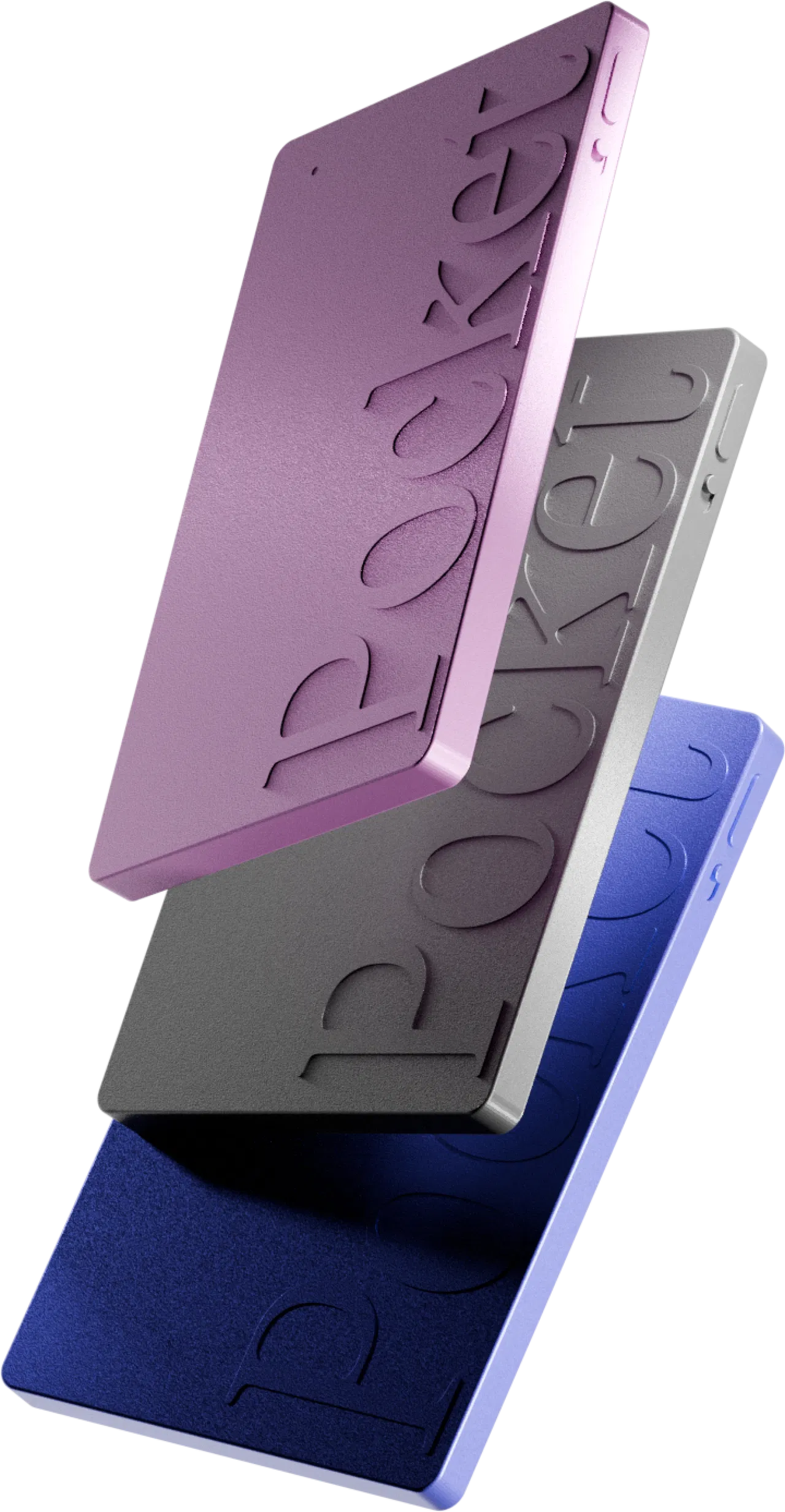
Not everyone wants a card that clips to a phone. The Plaud NotePin (and NotePin S) is a wearable pin you clip to your shirt – great for nurses on rounds, teachers, or consultants who need hands-free capture, with ~20 h recording and 40 days of standby. Pocket is a small, screenless device that magnets to your phone (MagSafe) or sits in a pocket, charges over USB-C, and runs 4 days on a charge. So this is really form factor vs form factor: choose the NotePin if you truly need a worn pin all day; choose Pocket if you want the same AI, more languages, a longer battery and no subscription in a discreet pocket device.
Pocket AI vs Plaud AI: model choice, Ask Pocket, MCP and subscriptions
Beyond hardware, the plaud ai vs pocket ai comparison comes down to software, control and cost. Model choice: Pocket lets you point captures at the AI model you want (many power users run Claude Opus) – the model decides how the summary reads and how action items are surfaced; Plaud uses a fixed pipeline, so the summary reads the way Plaud’s stack writes it. MCP server: both now ship one (Plaud added its in May 2026), so your transcripts are queryable directly from Claude Code, Claude Desktop or ChatGPT – ask a question, get the answer with a link to the original recording, without opening the app. Subscriptions: Plaud’s AI runs on a minute system (300 free/month, then paid plans); Pocket’s AI is included for life. Ask your recordings: Pocket’s “Ask Pocket” lets you query any recording in plain language. Both also have a desktop app (Mac and Windows).
Pocket vs Plaud: what a year actually costs
Sticker price is not the real price, so here is the honest pocket vs plaud cost picture. Pocket is ~$129 one-time, AI included, with an optional Pocket Pro plan (~$19.99/mo) that adds advanced models and AI speaker labels. Plaud starts at ~$159 (Note) up to ~$189 (Note Pro), then meters transcription: 300 free minutes/month, then Pro (~$8.33/mo billed annually) or Unlimited (~$19.99/mo). Over a year, a light user stays near hardware cost on either – but a heavy Plaud user realistically spends ~$369-429 in year one once minutes and features scale. With Pocket, everyday recording stays at the one-time price. That single line is why most people searching pocket vs plaud end up choosing Pocket.
Which buyer are you? Pocket vs Plaud by use case
Not sure where you fall? Use this quick guide. Founders and solo consultants who want one device, one press and fast recall after meetings lean Pocket. Sales teams and documentation-heavy roles that need reusable templates, 27+ export formats and team controls lean Plaud. Healthcare, legal and regulated buyers who need signed compliance lean Plaud’s certifications. Operators already living in Claude Code or ChatGPT lean Pocket for model choice plus MCP. And anyone allergic to a monthly bill leans Pocket. Match the device to how – and where – you actually record.
One practical note for both: recording-consent laws vary by country and by US state (one-party vs all-party consent). Whichever you pick, disclose recording when required – it is good practice regardless of jurisdiction, and it keeps the trust that makes a recorder useful in the first place.
Pocket vs Plaud vs Otter: what about software-only note takers?
If you only ever record online meetings, a software tool like Otter (or Granola) may be enough – no device to buy. But in the plaud vs pocket vs otter picture, software note takers rely on a monthly subscription and capture in-person conversations and phone calls poorly. Pocket and Plaud are hardware-first, so they capture the real world – meetings, calls, hallway chats – that Otter can’t. Many people who buy Pocket end up cancelling a software subscription they were only using out of habit. If your recordings happen away from a laptop, a device wins; and among devices, Pocket wins on price and no-subscription.
Where Plaud still beats Pocket
To keep this pocket vs plaud comparison honest, Plaud keeps real advantages. Its app and web portal are more mature – long-time users say it “just works”: drop it on the table, have everyone introduce themselves once, and speaker labels stay clean. It offers 27+ export formats, reusable templates and automations. Its compliance stack is broad (ISO 27001, ISO 27701, SOC 2 Type II, HIPAA, GDPR, EN 18031). And its speaker separation is a strength. Pocket, by comparison, is the faster-moving product: the team is unusually responsive, the community board is active, and updates ship quickly – though a few advertised extras (calendar, checklists) are still maturing. If you want the polished, established option today, Plaud is the safer pick; if you want the product improving fastest with no minute anxiety, Pocket is the call.
Pocket vs Plaud: which one should you buy?
Buy Pocket if you record often, want to pay once with no subscription, value unlimited recording, a 15 m mic range and USB-C, work across many languages, or want to choose the AI model that writes your notes. Buy Plaud if you need HIPAA-grade compliance, a worn pin (NotePin), the Note Pro’s marathon battery, a very mature app, or 27+ export formats – and you don’t mind the subscription. For most people, the pocket vs. plaud answer is Pocket: same AI, more languages, lower total cost, no monthly bill.
FAQ – Pocket vs Plaud
Is Pocket better than Plaud?
For everyday use and value, yes – Pocket matches Plaud’s core AI (transcription, summaries, tasks, mind maps) while adding “Ask Pocket”, model choice, more languages and, crucially, no subscription for a lower one-time price. Plaud stays ahead on app maturity and compliance.
Are Pocket’s free minutes really unlimited, or do I need a yearly subscription?
Pocket includes unlimited recording and core AI in the one-time price – no subscription required. An optional Pocket Pro plan adds advanced models and AI speaker labels. Plaud, by contrast, gives 300 free minutes a month, then charges once you go over.
Which has more concise summaries, Pocket or Plaud?
Plaud’s summaries are often a touch more concise and its transcript-editing tools are more mature. Pocket’s are fully serviceable and, because you can pick the AI model, you can tune how they read.
Does Plaud have mind mapping like Pocket?
Yes – both build mind maps from a conversation. Pocket adds “Ask Pocket” for plain-language Q&A on any recording.
Can I cancel my Otter subscription if I get Pocket?
If your recordings mostly happen in person or on phone calls, a hardware recorder like Pocket replaces what a software bot like Otter does on video calls, and many users drop Otter. If most of your meetings are on Zoom or Teams, keep a software tool for those.
Hey Pocket vs Plaud – is “Hey Pocket” the same as Pocket?
Yes. “Hey Pocket” (heypocket) is simply the brand name of Pocket, so a hey pocket vs plaud review is the same comparison you just read.
Is there a money-back guarantee?
Pocket is sold with a money-back guarantee, so you can put it head-to-head with your Plaud and keep the one that wins.
Final verdict
In 2026, the pocket vs plaud winner for most buyers is clear: Pocket AI delivers the full AI note-taking experience – transcripts, summaries, tasks, mind maps and Q&A – with unlimited recording, more languages, a 15 m mic range, model choice, a desktop app and no subscription, at a lower one-time price. It is already used by 160,000+ creators, founders and professionals and ships with a money-back guarantee, so you can test it against your Plaud risk-free. Plaud remains a superb choice for compliance-heavy work, a specific form factor, or app maturity. Rating: Pocket 4.5/5.