Looking for the best AI voice recorder with transcription and drowning in gadgets that all promise to “write everything down for you”? The short answer: among the AI devices that actually transcribe (Pocket, Plaud Note and Note Pro, Plaud NotePin S, Soundcore Work, Notta Memo, iFlytek Smart Recorder), my pick for 2026 is Pocket. It’s the only one in this comparison that transcribes without a minute cap and without a subscription, with summaries, tasks and mind maps included, for a one-time $129 (around €129 in Europe). Plaud still wins on large-room pickup and app maturity, and I’ll say so clearly below.
Here I only compare AI devices that transcribe, criterion by criterion (accuracy in your language, languages, summaries, cost, privacy). If you want a wider ranking that also covers classic Sony or Olympus recorders and software tools, read my guide to the best pocket voice recorder. And if your only question is the long-term price, I ran the numbers in AI voice recorder with no subscription. Updated September 2026.
My 5 criteria for choosing an AI voice recorder with transcription 🔍
An AI recorder isn’t just a microphone: it’s a mic plus a software pipeline (transcription, summary, search). So I judged each device on what you actually get back after pressing the button.
- Transcription accuracy in your language: names, numbers, industry jargon, accents, several people talking.
- Languages: the headline number, but above all how well your language is handled and what happens when a meeting switches languages.
- Summaries and what you can do with them: recaps, tasks, search, asking questions of your recordings.
- The real cost of transcription: free minutes, subscriptions, price over a year of regular use.
- Privacy: where your conversations go, encryption, certifications.
For Pocket, I rely on my own daily use. I haven’t personally tested every other device: for those I rely on the brands’ official spec sheets and published reviews (TechRadar, Clubic, Galaxus, Plateya and others), checked in September 2026.
The comparison at a glance 📊
Two rows matter more than the rest: free transcription (almost everyone caps it at 300 minutes a month) and languages. Let’s go criterion by criterion.
Criterion 1: transcription accuracy 🎯
Let’s be honest: no AI recorder is 100% accurate. Errors always land in the same places: proper names, acronyms, fast numbers, jargon and code-switching between languages. Accuracy depends as much on the mic and the distance as on the AI engine.
Pocket: in my daily use (meetings, phone calls, personal notes on walks), transcripts are faithful and punctuated, split by speaker turn and timestamped. Two settings make a real difference: the custom vocabulary for industry terms and names, and the choice of AI model for summaries. Its weak spot: in a packed café or a busy street, accuracy drops, as with any microphone. Also worth knowing: the free plan uses standard accuracy, while highest-accuracy transcription is part of the optional Pro plan.
Plaud Note and Note Pro: published reviews are solid but not flawless. In French, Plateya counted 9 errors in a 30-minute meeting on the Note Pro; in German, Galaxus found mistakes on technical terms and proper nouns. The Note Pro, with 4 mics and beamforming, handles noise better, which helps accuracy.
Soundcore Work: Clubic found it reliable when everyone speaks one language, but it struggles when a meeting mixes languages.
Notta Memo: TechRadar reported “almost 100%” accuracy in its English testing across lectures, cafés and offices. That’s the strongest English result I found.
iFlytek Smart Recorder: it transcribes offline in real time, in Chinese, English, Japanese, Korean and Russian only. Good for English speakers who want offline transcripts, useless if you also work in Spanish, French or German.
Criterion 2: supported languages 🌍
On paper the numbers race is impressive: 150+ languages for Soundcore Work, 120+ for Pocket, 112 for Plaud, 58 for Notta Memo and 5 for the iFlytek Smart Recorder. In practice, two questions matter more than the total.
- Is your main language handled well? English works on all six. Other languages drop the iFlytek right away, and Notta Memo’s 58 languages cover far less ground.
- Do bilingual meetings work? This is the weak point cited for Soundcore Work and Plaud. With Pocket, 120+ languages cover international meetings, but everywhere a switch in the middle of a sentence remains hard.
Criterion 3: summaries, tasks and search 🧠
A raw transcript is a wall of text. The real value is what the AI does with it.
Pocket turns each conversation into five outputs: replayable audio, transcript, structured summary, task list and mind map. You can choose the AI model that writes your summaries, change the style with themes, and get your summaries emailed automatically. The feature I use most is Ask Pocket: I ask a question in plain English (“what did we decide about the budget?”) and the AI finds the answer across all my conversations. One caveat: on the free plan, Ask Pocket is limited to 2 messages a day and summaries are kept for 30 days.
Plaud is still the benchmark on software: 10,000+ summary templates, speaker labels that persist across sessions and 27+ export formats. If you produce highly standardized minutes, that’s a real advantage.
Soundcore Work does summaries, but Clubic found them less structured than Plaud’s, and noted no web or desktop app.
Notta Memo benefits from the Notta ecosystem: summary templates, action items and real-time translation across its 58 languages.
Criterion 4: the real cost of transcription 💵
This is the criterion that made my decision. Almost every device here follows the same model: you buy the hardware, then you pay for transcription beyond 300 minutes a month, which is 5 hours. Two or three meetings a week and you’re over.
- Plaud (Note $159, Note Pro $189, NotePin S $179): 300 free minutes a month, then $99.99/year (Pro, 1,200 min/month) or $239.99/year (Unlimited), per Plaud’s pricing page.
- Soundcore Work (from $159 on Anker’s site, often discounted): 300 free minutes a month, then Pro ($99.99/year) or Unlimited ($239.99/year).
- Notta Memo ($149 on Notta’s site): 300 minutes a month on the Starter plan, then a subscription.
- iFlytek Smart Recorder (around $128 on sale): offline transcription with no subscription, but only 5 languages.
- Pocket ($129 one time, up to 45% off right now): unlimited transcription and summaries, free for life. The Pro plan ($19.99/month or $199/year) is optional.
Over three years of regular use, the gap runs into hundreds of dollars. I did the model-by-model math in AI voice recorder with no subscription, so I won’t bury you in numbers here.
Criterion 5: the privacy of your conversations 🔒
AI recorders usually send your audio to the cloud to transcribe it. You need to know where and how.
- Pocket: end-to-end encryption, HIPAA compliance, data stored on the device or on US servers, and a commitment that it’s never sold or shared.
- Plaud: the broadest certification stack (ISO 27001, SOC 2 Type II, HIPAA, GDPR).
- Soundcore Work: AES-256 encrypted audio stored locally, deletion after transcription, SOC 2 Type I according to Anker.
- Notta Memo: SOC 2, ISO 27001, GDPR and HIPAA according to Notta, but a cloud connection is required for AI features.
- iFlytek: offline transcription is the most private option, as long as its 5 languages are enough.
Whatever the device, consent rules vary by country and by US state. Tell people you’re recording when the law requires it.
The devices one by one 🧩
Pocket: my pick for transcribing without counting minutes
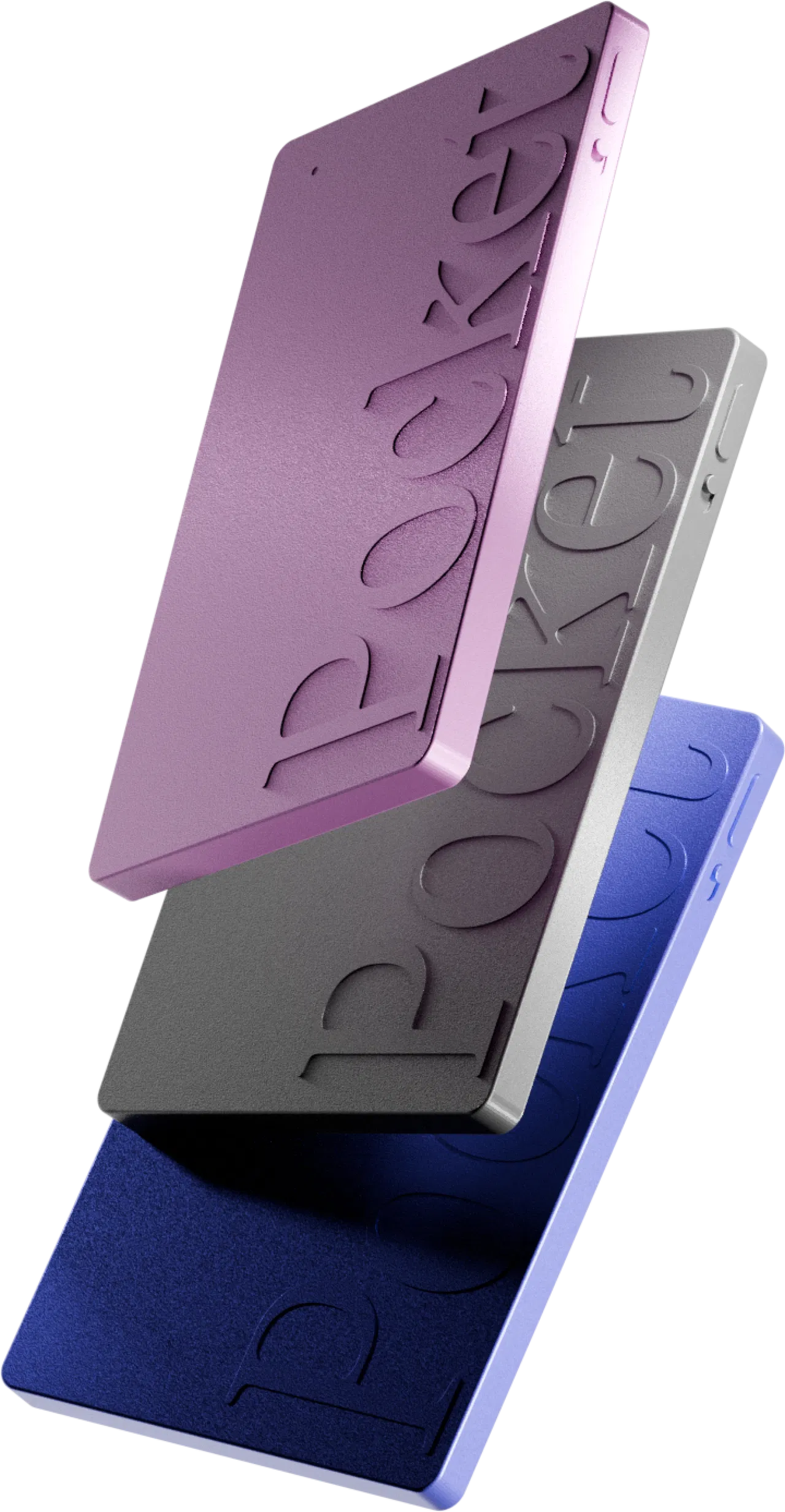
A 52 g card-sized device with no screen and one button, two studio mics (up to 15 m / 49 ft range) and a contact mic that captures phone calls without speakerphone. 4-day battery, USB-C, 64 GB plus unlimited cloud. Its limits: it isn’t made for Teams or Zoom calls, and the brand is young. Everything is in my full Pocket review.
Plaud Note and Note Pro: the hardware benchmark
The Note Pro ($189) has the best pickup: 4 mics with beamforming, 5 m range, up to 50 hours of recording, AMOLED screen. But calls are recorded via speakerphone only, and beyond 5 hours a month you need a subscription. My take on the whole lineup: Plaud Note review.
Plaud NotePin S: the wearable
A 17.4 g pin you clip on, with a physical button to mark key moments. Handy on the move, but it doesn’t record phone calls and shares the same minute model as other Plauds.
Soundcore Work: the smallest and cheapest
Coin-sized (about 10 g), 8 hours of recording (32 with the case). Clubic gave it 6/10: over-sensitive button, weaker summaries. An entry-level choice if you record little.
Notta Memo: the challenger to watch
MagSafe card format, bone-conduction sensor for calls, 30-hour battery, live translation. Rated highly by TechRadar for English accuracy, but 58 languages, a proprietary charging cable and 300 free minutes a month.
iFlytek Smart Recorder: offline, 5 languages
Touchscreen, real-time offline transcription, pickup up to 10 m. Good for English or Chinese, but no Spanish, French or German.
Who is it for? My pick by use case 🎯
- You go from in-person meetings to phone calls all day: Pocket. Unlimited transcription, contact mic for calls, automatic tasks.
- You run 10-person meetings in a big, noisy room: Plaud Note Pro, the best at pickup, if a subscription doesn’t bother you.
- Your meetings are mostly on Teams or Zoom: software or Plaud’s desktop app will suit you better than a device.
- You want a pin to wear all day: Plaud NotePin S, knowing it won’t record calls.
- You record under 5 hours a month and want the lowest price: Soundcore Work may be enough.
- You only work in English and want offline transcripts: the iFlytek is worth a look.
Still torn between the two favorites? My Pocket vs Plaud head-to-head covers every line.
FAQ – AI voice recorder with transcription ❓
What is the best AI voice recorder with transcription?
For regular use, my pick is Pocket: unlimited transcription with no subscription, plus summaries, tasks and mind maps. Plaud Note Pro picks up better in large rooms, but free transcription is capped at 300 minutes a month.
Is there an AI recorder with free, unlimited transcription?
In this comparison, only Pocket includes unlimited lifetime transcription in the purchase price. Plaud, Soundcore Work and Notta Memo give you 300 minutes a month, then ask for a subscription. The iFlytek transcribes offline with no subscription, but only in 5 languages.
Is AI transcription 100% accurate?
No, on any device. Names, numbers, acronyms and language switches remain weak spots. A custom vocabulary, like Pocket’s, and a device placed in the middle of the table noticeably cut errors.
Can these devices transcribe phone calls?
Yes with Pocket (contact mic, no speakerphone) and Notta Memo (bone-conduction sensor). Plaud Note and Note Pro do it via speakerphone. The NotePin and NotePin S don’t record calls. Check consent rules where you live.
Do they work for Teams or Zoom?
Not really: they’re built for in-person conversations and phone calls. For video meetings, a software tool or Plaud’s desktop app is a better fit. Pocket is clearly less practical there.
My verdict: Pocket, to transcribe without counting 🏁
If you want an AI voice recorder with transcription for real use, several times a week, the deciding factor isn’t the number of languages or a screen: it’s how many hours you can transcribe without paying again. On that point Pocket stands alone in this comparison, with unlimited lifetime transcription, summaries, tasks, mind maps and Ask Pocket for a one-time $129. Plaud remains excellent if you record little or in very large rooms, and I won’t pretend otherwise.
My advice: start on Pocket’s free plan, grab the current offer and test it on your real meetings. You get a 30-day money-back guarantee to judge for yourself. 👇
This article reflects my personal experience with Pocket and published reviews for the other devices. It contains affiliate links: if you buy through them, I may earn a commission at no extra cost to you.